In 2026, TikTok users are navigating a rapidly shifting digital landscape: over 45% of countries have implemented some form of restriction on the platform, making consistent access harder than ever before. These barriers aren’t limited to government-level bans — they’re routinely embedded within school networks, corporate firewalls, and regional ISP policies, leaving creators, marketers, and casual users alike cut off from one of the world’s most influential platforms. Knowing how to work around these restrictions isn’t just a technical curiosity; for millions of people whose livelihoods and communities live on TikTok, it’s a practical necessity. This article breaks down the real-world access challenges TikTok users face in 2026, explains how proxies and VPNs work as unblocking tools, and walks through the technical steps for configuring them effectively. We also take an in-depth look at GenLogin — a professional browser automation platform built for secure, scalable management of multiple TikTok accounts. Whether you’re a content creator protecting your reach or a digital marketer running campaigns across regions, these strategies will help you stay connected and operational despite the growing wave of digital restrictions.
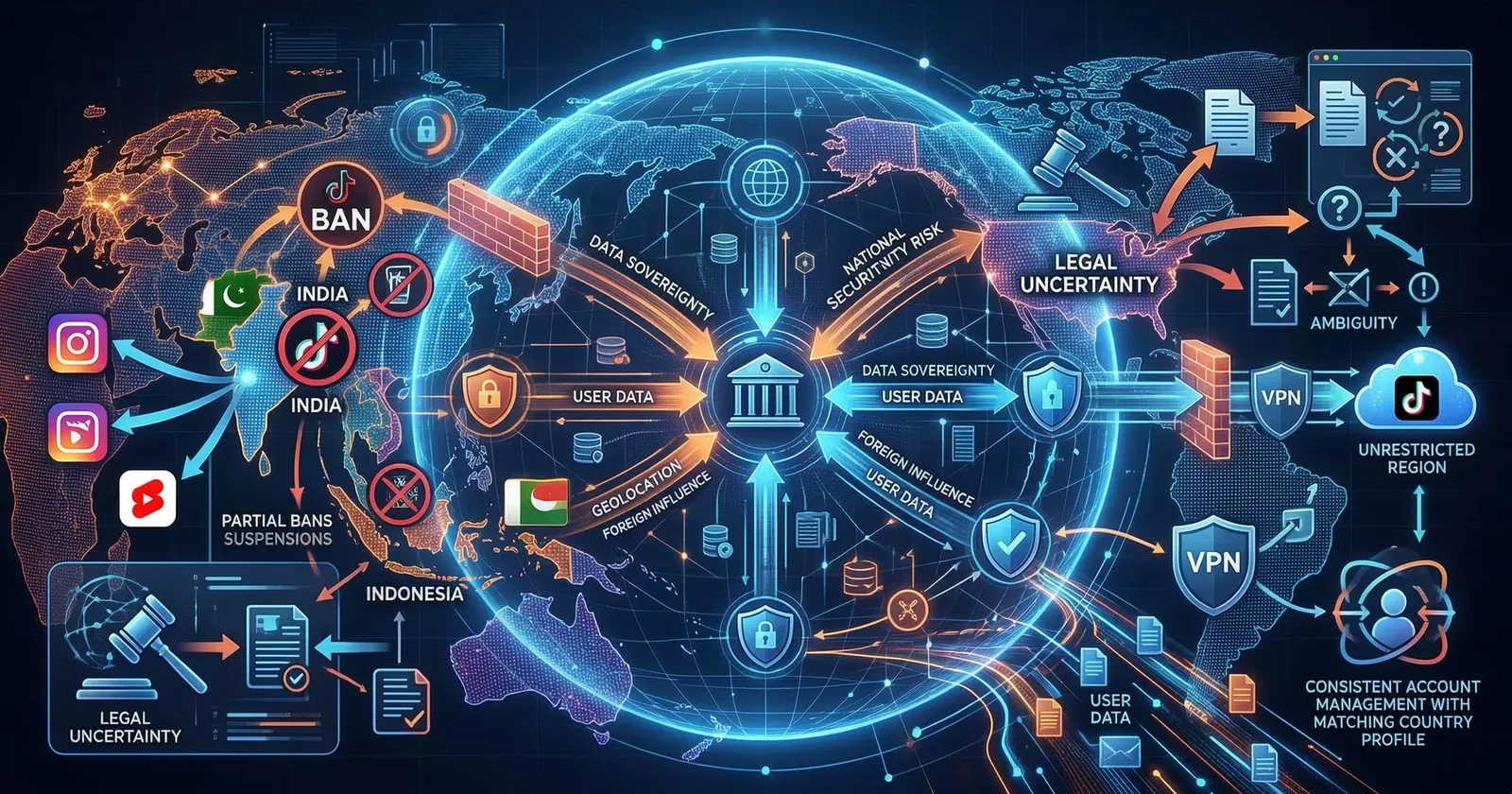
As of 2026, TikTok operates under some form of restriction in dozens of markets worldwide, affecting hundreds of millions of users who rely on the platform for entertainment, community, and income. India’s outright ban — in place since 2020 — removed what was once the platform’s single largest audience, accounting for over 30% of global downloads at its peak. Pakistan and Indonesia have imposed partial bans and recurring suspensions driven by content moderation concerns. In the United States, legislative pressure and executive actions have created ongoing legal uncertainty, leaving American creators in a prolonged state of ambiguity about the platform’s future.
The underlying reasons for these restrictions are consistent across governments: concern over data sovereignty, national security risk associated with ByteDance’s Chinese ownership structure, and apprehension about foreign influence over domestic information ecosystems. Regulators in multiple countries have cited evidence — or the credible possibility — that user data collected by TikTok could be accessed by the Chinese government under Beijing’s national security laws. These aren’t fringe concerns; they’ve been raised by intelligence agencies in the US, UK, EU, Australia, and India, lending geopolitical weight to what might otherwise appear to be platform-specific disputes.
For content creators, the human cost of these restrictions is real and significant. In India, influencers who had built audiences of millions and depended on TikTok as a primary income source were forced to migrate abruptly to Instagram Reels and YouTube Shorts — platforms with different algorithms, monetization models, and audience behaviors. Many saw engagement drop significantly in the transition. For users in restricted regions who still want access, VPNs have become the default workaround, though inconsistent performance and the risk of violating platform terms of service introduce friction of their own.
The practical response for most affected users is to combine a reliable VPN with a disciplined approach to account management — using the VPN to establish access from an unrestricted region and keeping the proxy or VPN location consistent with the account’s registered country to avoid triggering security reviews. Understanding exactly why TikTok is restricted in your region is the first step toward choosing the right technical solution for your specific situation.
The access challenges TikTok users face in 2026 aren’t abstract policy problems — they play out in concrete, costly ways for individuals and businesses every day. Consider a digital marketer based in the UAE or Egypt, where TikTok access is restricted or heavily monitored. This person runs paid campaigns on TikTok for e-commerce clients, manages creator partnerships, and tracks performance analytics in real time. A sudden IP block doesn’t just create inconvenience — it interrupts active campaigns, breaks reporting workflows, and potentially costs clients revenue while the issue is being resolved.
The mechanism behind these blocks is straightforward but hard to circumvent without the right tools. Internet service providers, operating under government mandate, flag TikTok’s IP ranges and domain names. When a user attempts to load the app or website, the request is intercepted at the ISP level and either redirected or dropped entirely. The platform never receives the connection request, and the user sees an error or a blank screen. For businesses running TikTok Ads Manager or using the platform’s API for analytics, these blocks affect not just passive consumption but active operational tooling.
The marketer in this scenario chose to route traffic through a residential proxy — a server that issues IP addresses assigned by a legitimate ISP in an unrestricted country, making the connection indistinguishable from organic residential traffic. Unlike data center proxies, which TikTok’s systems are trained to detect and flag, residential proxies present as ordinary user traffic. By selecting a proxy provider with servers in the US or UK and configuring each TikTok account to consistently use the same proxy endpoint, the marketer was able to restore full platform access, maintain stable sessions, and continue running campaigns without interruption.
The wider lesson from cases like this is that proxy selection is not a commodity decision. The wrong choice — shared IPs, unreliable uptime, mismatched geolocation — can make the problem worse by triggering account-level bans on top of the original access restriction. The right choice, made with attention to proxy type, location consistency, and provider reputation, effectively eliminates the access problem while preserving account standing.
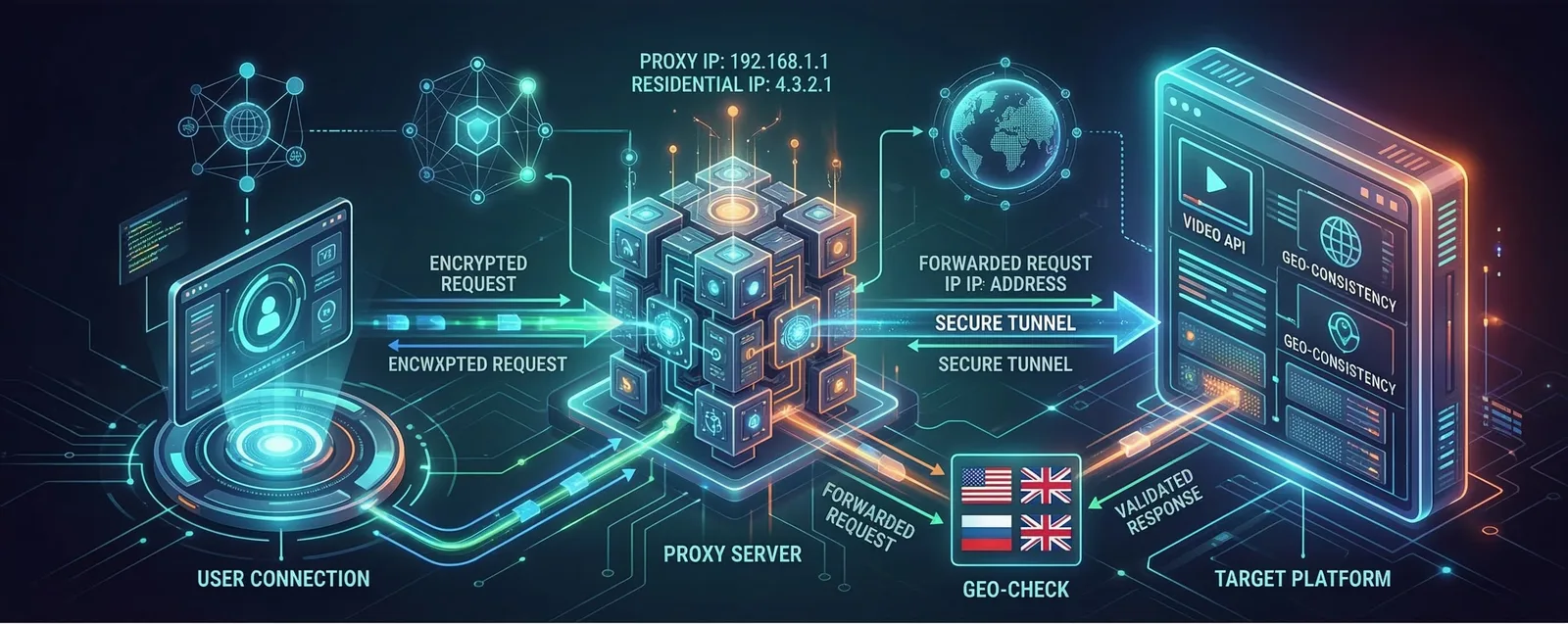
At a technical level, proxies solve the TikTok access problem by inserting an intermediary server between the user’s device and TikTok’s infrastructure. The user’s connection request travels to the proxy server first; the proxy then forwards the request to TikTok using its own IP address. From TikTok’s perspective, the request originates from the proxy server’s location — not the user’s actual geographic location. If the proxy is located in an unrestricted country, TikTok serves the content normally, and the user gets access.
The type of proxy matters enormously for TikTok specifically. Residential proxies — those assigned real IP addresses by consumer ISPs — are the most effective option because they are indistinguishable from legitimate user traffic. TikTok’s bot detection systems are primarily calibrated to flag data center IP ranges, which are easily identified by their ASN (Autonomous System Number) as belonging to commercial hosting providers rather than residential networks. A well-sourced residential proxy bypasses this detection layer cleanly. Data center proxies are faster and cheaper but carry a meaningfully higher risk of being flagged, especially for accounts that have existing history and accumulated value.
One of the most commonly overlooked configuration details is geographic consistency between the proxy location and the account’s registration country. If a TikTok account was created and has historically been accessed from the United States, suddenly routing sessions through a Southeast Asian proxy server creates a location anomaly that TikTok’s security systems are designed to detect. The platform interprets this as a potential account compromise and may trigger a verification challenge or temporary lock. Matching the proxy’s exit node location to the account’s registered country eliminates this risk entirely.
For users selecting a proxy provider, the practical criteria are: residential IP pool (not data center), multiple server locations with the ability to pin to a specific country, high uptime SLA, and no IP sharing across multiple users simultaneously. Providers that rotate IPs too aggressively can also cause issues — TikTok’s session management expects some degree of IP consistency across a single session. Tools like Pixelscan and Whoer allow users to verify what information their proxy is actually broadcasting before committing to a configuration.
The proxy selection decision for TikTok comes down to four variables: IP type, geographic coverage, session stability, and security hygiene. On IP type, the guidance is unambiguous — residential proxies are the correct choice for TikTok. The platform’s anti-bot infrastructure is specifically tuned to detect non-residential traffic patterns, and the cost premium of residential proxies is justified by the significantly lower account risk they carry compared to data center alternatives.
Geographic coverage matters both for access (you need a server in an unrestricted country) and for account safety (that server should match the account’s registered location). A provider with a large, diverse residential IP pool — covering the US, UK, Germany, Australia, and other major markets — gives you the flexibility to manage accounts registered in different countries without compromising either access or consistency. Verify location accuracy using tools like IPFighter before going live with any account.
Session stability is often underweighted in proxy evaluations but is critical for TikTok specifically. Video streaming, live sessions, and Creator Marketplace interactions require sustained, low-latency connections. A proxy that drops frequently or introduces significant jitter will degrade the user experience even when access itself is unblocked. Test connection quality under realistic load before committing to a provider for production use.
Security hygiene is the final consideration: never use free or shared public proxies for TikTok account access. Free proxies are almost universally shared across hundreds or thousands of users simultaneously, meaning your account’s IP is also being used by unknown third parties — including, potentially, actors whose behavior has already triggered TikTok bans. The contamination risk to your own account is not theoretical; it’s a well-documented failure mode that has resulted in platform-wide IP bans on heavily shared proxy pools.
Proxies and VPNs solve overlapping but distinct problems in the TikTok access context, and understanding where each excels helps users deploy them intelligently — either individually or in combination. A proxy’s primary function is IP substitution: it replaces your visible IP address with one from an unrestricted location, enabling geographic access. It does this efficiently and with minimal latency overhead, making it well-suited for high-bandwidth use cases like video streaming and live broadcasting. However, standard proxies do not encrypt your traffic — the data payload traveling between your device and the proxy server is visible to anyone monitoring the network path.
A VPN provides both IP masking and end-to-end encryption. All traffic between your device and the VPN server is encrypted using protocols like WireGuard or OpenVPN, making it unreadable to ISPs, network administrators, or surveillance infrastructure along the route. This makes VPNs the stronger tool for privacy protection and for users in environments where network-level monitoring is a genuine concern. The tradeoff is speed: the encryption overhead introduces latency, and VPN server capacity constraints can further reduce throughput during peak usage.
| Feature | Proxy | VPN |
|---|---|---|
| Functionality | Routes traffic through a server | Encrypts and routes all traffic |
| Security | Basic IP masking | Advanced encryption |
| Speed | Generally faster | Can be slower due to encryption |
| Best Use Case | Bypassing regional restrictions | Secure and private browsing |
The most robust approach for users in high-risk environments — where both access restriction and active network surveillance are concerns — is to layer both tools. The proxy handles the geographic access problem efficiently, while the VPN wraps the entire connection in encryption before it even reaches the proxy layer. The practical cost is some reduction in throughput, which most users find acceptable given the security benefit. For users whose primary concern is simply bypassing a geo-block with minimal friction, a quality residential proxy alone is typically sufficient.
For users who want a single tool that handles both concerns, reputable VPN providers like NordVPN or Mullvad offer residential IP options in their server networks, partially bridging the gap between the two tool categories. That said, for multi-account management at scale — which introduces additional complexity around fingerprinting, session isolation, and behavioral consistency — a dedicated proxy solution integrated into a browser management platform like GenLogin provides significantly more control than a VPN alone.
Configuring a proxy correctly is where most users either solve their access problem cleanly or introduce new ones. According to data from proxy usage surveys, over 40% of users who successfully bypassed TikTok restrictions did so using properly configured residential proxies — while a comparable share of failed attempts were traced back to misconfiguration rather than the proxy service itself. Follow these steps to get it right:
The most common configuration mistakes are: using a data center proxy instead of residential, failing to verify geolocation accuracy before account login, and sharing proxy endpoints across multiple accounts simultaneously. Each of these mistakes creates a distinct failure mode — detection, location mismatch, and IP contamination, respectively — that can result in account suspension even when the underlying proxy service is functional.
Once configured, monitor connection stability regularly. If you notice session drops, increased CAPTCHA frequency, or login verification prompts, these are early indicators that TikTok’s systems are scrutinizing your connection — a signal to rotate to a fresh proxy endpoint before the situation escalates to an account action.
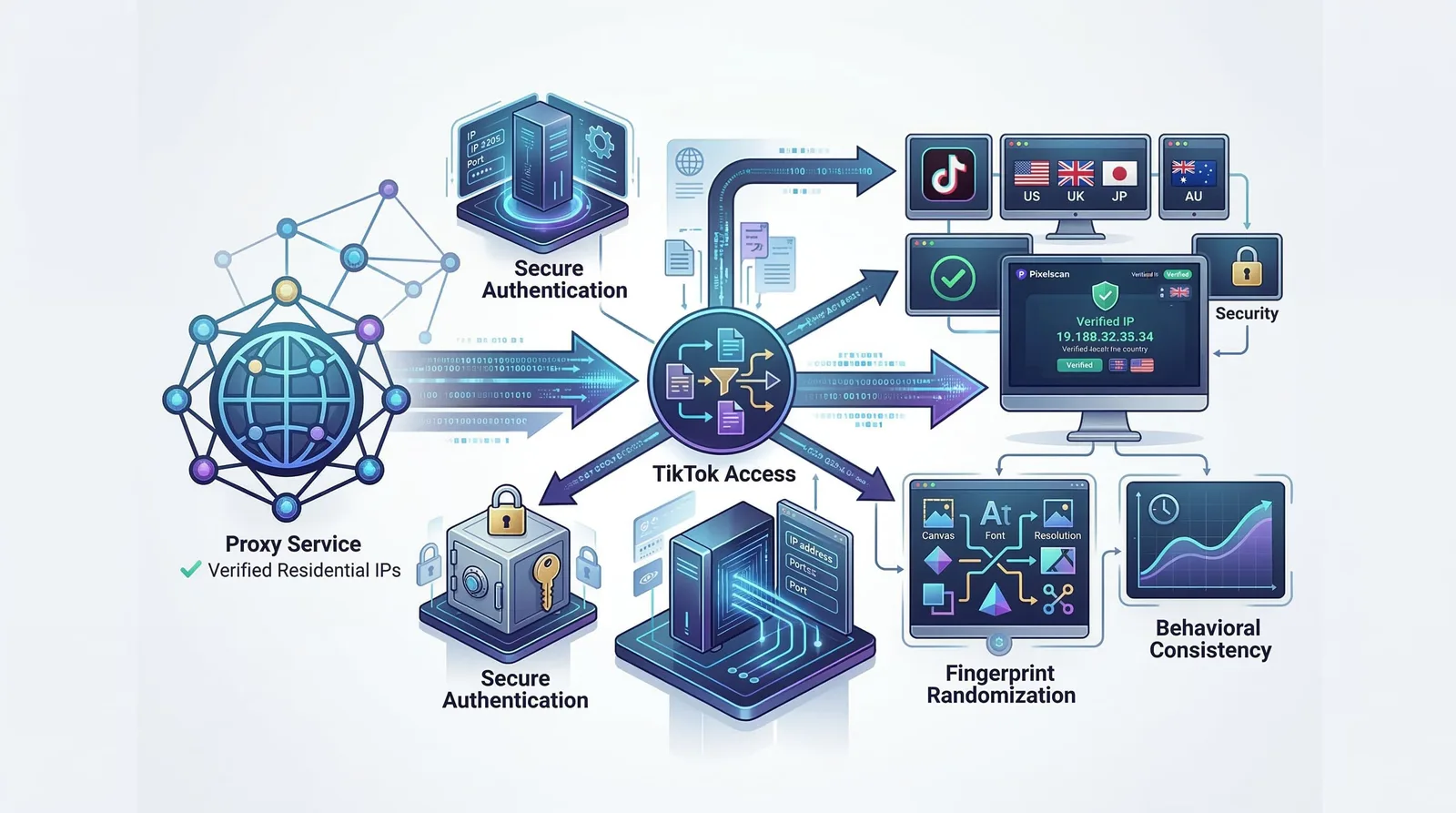
For users in highly restricted environments or those managing accounts with significant business value, standard proxy configuration is a starting point — not an endpoint. Advanced security measures reduce the attack surface further and make proxy usage significantly harder to detect at scale.
Browser fingerprint randomization is the most important advanced layer. Even with a clean residential IP, TikTok’s web client collects dozens of device and browser signals — canvas fingerprint, WebGL renderer, screen resolution, installed fonts, navigator properties, timezone, and more. If these signals are inconsistent with the declared proxy location (for example, a timezone set to UTC+7 while the proxy shows a US IP), TikTok’s fraud detection systems flag the discrepancy. Tools like GenLogin address this by generating coherent, per-profile browser fingerprints that are internally consistent and aligned with the proxy’s geographic context — effectively eliminating the fingerprint mismatch vector.
Behavioral consistency is equally important. Avoid changing proxy endpoints between sessions on the same account unless necessary. TikTok’s session intelligence tracks IP continuity as a trust signal; frequent IP changes — especially across geographically distant locations — register as anomalous and can trigger account locks. When a proxy rotation is necessary, allow a cooling-off period before the next session and avoid high-value account actions (posting, going live, accessing monetization settings) in the first session after a switch.
Finally, ensure your proxy provider offers transport-layer encryption between your device and the proxy server. This protects your credentials and session data from interception on the local network — particularly relevant for users accessing TikTok from corporate or institutional networks where traffic inspection is common practice.
Managing multiple TikTok accounts is a standard operational requirement for digital marketing agencies, creator management firms, and brands running regional campaign strategies. Done without the right infrastructure, it’s also one of the fastest ways to accumulate account bans. TikTok’s anti-abuse systems are specifically designed to identify and terminate account clusters that share device fingerprints, IP addresses, or behavioral patterns — and the consequences of a poorly managed multi-account setup can cascade across an entire account portfolio simultaneously.
GenLogin is built to solve this problem systematically. The platform provides isolated browser profiles, where each profile maintains its own unique fingerprint, cookie store, local storage, and proxy assignment. From TikTok’s perspective, each profile is a completely independent device operated by a distinct user — because, at every measurable signal level, it is. There is no shared state between profiles that could allow TikTok’s systems to correlate them into a cluster.
The proxy integration layer in GenLogin is particularly well-suited to TikTok workflows. Users can assign a dedicated residential proxy to each profile and configure the browser fingerprint to match the proxy’s location — ensuring that timezone, language settings, keyboard layout, and geolocation signals all align coherently. This eliminates the most common detection vector for multi-account operations: the inconsistency between declared location (proxy IP) and device behavior (fingerprint signals). For agencies managing accounts across multiple countries, GenLogin’s script marketplace also provides automation tools that can handle routine account activity — content scheduling, engagement actions, analytics pulls — at scale without requiring manual intervention on each profile.
One important operational note: the strength of any multi-account setup built on GenLogin is directly tied to the quality of the proxy layer underneath it. GenLogin handles the fingerprint isolation and browser-level separation perfectly; but if two profiles share the same proxy IP — or if the proxy being used is a heavily shared data center endpoint — the account-level separation GenLogin provides is undermined at the network layer. Pair GenLogin profiles with dedicated residential proxies, one per account, for the most robust isolation.
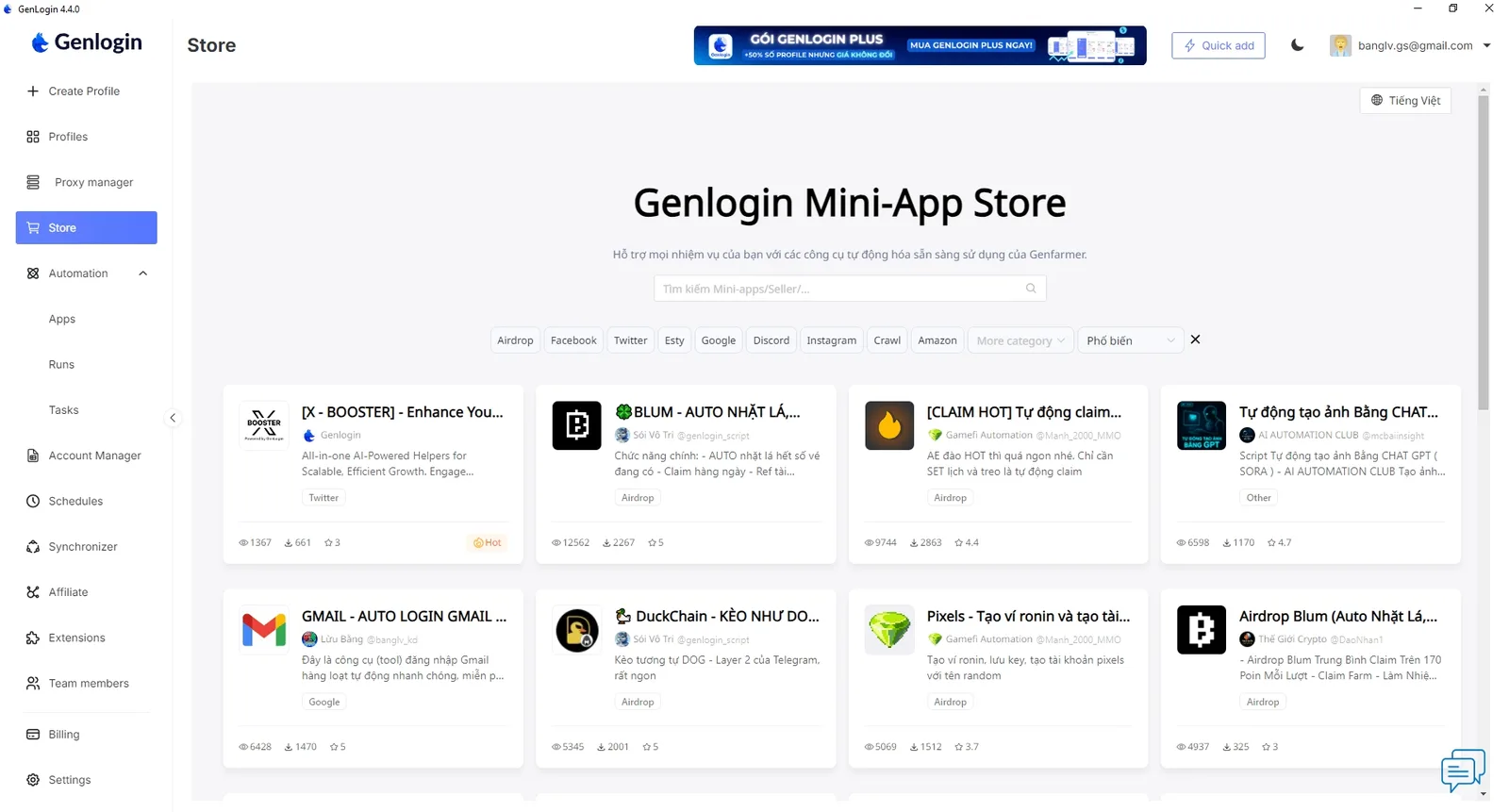
GenLogin’s feature set maps directly onto the technical requirements of serious TikTok multi-account management. Profile isolation is the foundation: each browser profile runs in a fully sandboxed environment with independent fingerprint parameters, ensuring that no behavioral or technical signal leaks between profiles. This is not just cookie isolation — it extends to canvas fingerprint, WebGL hash, audio context, navigator properties, and dozens of other signals that TikTok’s client-side scripts actively probe.
Proxy integration is native and flexible. GenLogin supports HTTP, HTTPS, SOCKS4, and SOCKS5 proxy protocols, and allows per-profile proxy assignment with geolocation-aware fingerprint configuration. Users can import proxy lists, assign them to profiles in bulk, and verify connection quality directly within the platform. The GenLogin interface surfaces IP geolocation data alongside each profile, making it easy to audit location consistency across an entire account portfolio at a glance.
Automation capabilities — accessible through the GenLogin script marketplace — allow teams to automate routine TikTok workflows without sacrificing the account safety that manual operation would otherwise provide. Scripts can be configured to introduce human-like timing variability in action sequences, reducing the behavioral signatures that TikTok’s systems use to distinguish automated activity from organic use. For social media managers handling daily posting schedules, comment management, and follower engagement across multiple client accounts, this automation layer substantially reduces operational overhead without increasing risk exposure.
Safety architecture is built into GenLogin’s core design rather than bolted on as an afterthought. The platform’s fingerprint generation engine produces browser profiles that pass active fingerprinting tests used by major platforms, including the canvas and WebGL probes that TikTok deploys. Profile parameters are configurable for users who need to fine-tune specific signals, but the default configurations are designed to be detection-resistant out of the box.
A fashion and lifestyle brand targeting audiences across Southeast Asia, the Middle East, and Western Europe needed to run region-specific TikTok accounts — each with localized content, local language captions, and engagement timing aligned with the target market’s active hours. Running these accounts from a single device without isolation infrastructure would have immediately flagged them as a coordinated cluster, risking simultaneous termination across all regional accounts.
The brand’s digital team implemented GenLogin with dedicated residential proxies assigned per account, each proxy sourced from a provider with verified residential IPs in the target market. Each GenLogin profile was configured with a browser fingerprint consistent with a device in the account’s target region — matching timezone, language, and screen resolution to the proxy location. Automation scripts from the GenLogin Marketplace handled daily content posting and engagement actions on a schedule aligned with each market’s peak hours, with randomized action timing to avoid behavioral pattern detection.
Over a 90-day campaign period, none of the regional accounts were flagged, suspended, or subjected to unusual verification challenges. Engagement rates on the localized accounts outperformed the brand’s previous single-account global strategy by a significant margin, and the team was able to iterate on content performance data from each market independently. The outcome validated both the technical approach — isolated profiles, matched proxies, coherent fingerprints — and the operational value of automating routine account management to free the team for higher-value creative and analytical work.
TikTok access restrictions in 2026 are a structural feature of the digital landscape, not a temporary anomaly — and for the creators, marketers, and businesses whose work depends on the platform, waiting for the geopolitical situation to resolve itself is not a strategy. The tools to work around these restrictions exist, are technically mature, and are used successfully by millions of users globally. Residential proxies solve the geographic access problem cleanly when configured correctly. VPNs add encryption and privacy protection for users in environments where network surveillance is a genuine concern. And for anyone managing more than one TikTok account — whether for a brand, an agency, or a personal multi-market creator strategy — the combination of proper proxy configuration and browser profile isolation is not optional; it’s the baseline for operating safely at scale.
This is precisely the operational context that GenLogin was built for. Its profile isolation architecture, native proxy integration, geolocation-aware fingerprinting, and automation capabilities address each of the technical challenges covered in this article in a single, coherent platform. The case study outcomes are consistent with what users across industries report: when the infrastructure is set up correctly, multi-account TikTok operations can run stably, safely, and at scale — without the constant firefighting that comes from improvised solutions.
If you’re managing TikTok accounts under restrictions or at scale, the next practical step is to explore what GenLogin’s platform can do for your specific workflow. Visit GenLogin to review the platform’s features in detail, or head directly to the GenLogin Marketplace to browse automation scripts built specifically for TikTok account management. A free trial is available — the most useful thing you can do right now is see how it performs against your actual use case.