In 2026, a staggering 90% of online shoppers trust Amazon reviews as much as personal recommendations — yet the vast majority of reviewers have no idea they’re sitting on a genuine income opportunity. As the digital marketplace matures, knowing how to turn review activity into a structured revenue stream has become a meaningful skill for content creators, affiliate marketers, and independent entrepreneurs alike. This year, the strategies that work have sharpened considerably: affiliate integration is more sophisticated, niche authority is more valuable than broad reach, and tools like GenLogin have made large-scale market research and data collection genuinely accessible to individual reviewers. This guide draws on current best practices, real-world case studies, and the legal landscape governing Amazon reviews in 2026 — giving you the actionable framework to monetize your review activity ethically, effectively, and at scale.
Amazon reviews have become one of the most consequential forces in consumer decision-making. With over 70% of online shoppers reading reviews before committing to a purchase, the aggregate influence of review content now rivals — and in many categories exceeds — traditional advertising. This isn’t just a behavioral trend; it’s a structural feature of how the Amazon marketplace functions. The platform’s A9 algorithm actively rewards products with higher review counts and stronger average ratings through elevated search placement, meaning that review velocity and quality directly determine commercial visibility.
The mechanism is self-reinforcing: products that accumulate reviews early gain algorithmic visibility, which drives more traffic, which generates more purchases, which produces more reviews. For sellers, this makes early review acquisition a strategic priority rather than a vanity metric. For reviewers who understand this dynamic, it creates a clear value proposition — their review activity has measurable commercial impact on the products they cover, which is the foundation of any legitimate monetization relationship.
Consider a small brand launching a new kitchen gadget in a competitive category. Without reviews, the product is effectively invisible — buried behind hundreds of established competitors in search results. A coordinated strategy of encouraging verified purchaser reviews, responding to early feedback to signal responsiveness, and maintaining review quality over time can move a product from page five to page one of search results within weeks. That visibility shift is worth thousands of dollars in incremental revenue, which is precisely why brands are willing to pay — in products, commissions, or fees — for credible reviewer relationships.
The flip side is equally important to understand: negative reviews are not merely a reputational inconvenience. A product sitting at 3.2 stars with unresolved complaints visible in the review thread experiences measurably lower conversion rates than a comparable product at 4.4 stars with actively managed feedback. For reviewers, this means the audience reading your content is highly motivated and highly attentive — qualities that translate directly into affiliate conversion rates when your recommendations are trusted.
To make the most of this environment, reviewers should develop a genuine understanding of how Amazon’s review ecosystem works — not just as consumers, but as participants with influence over the outcomes that sellers care about most.

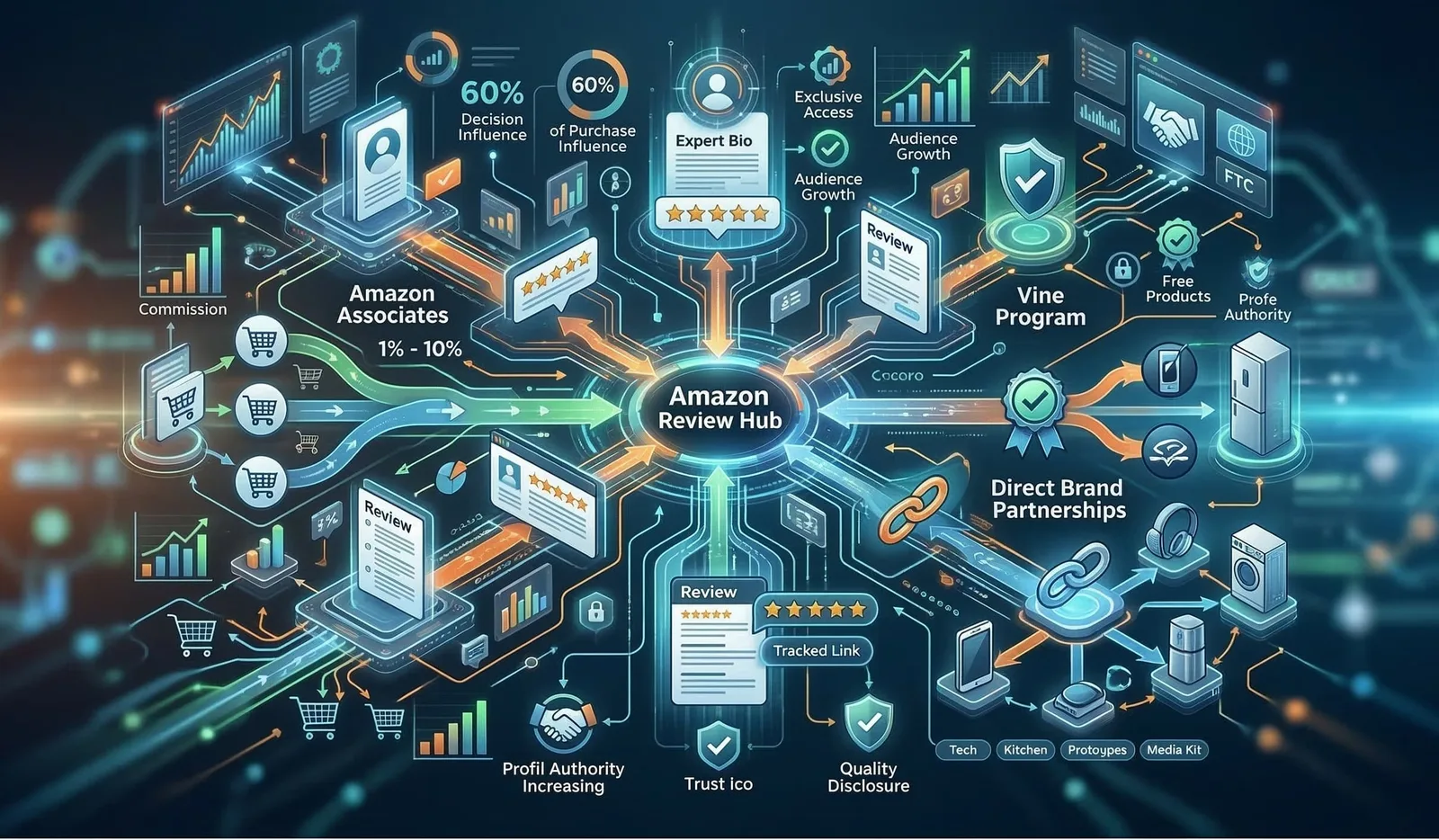
Monetizing Amazon reviews is not a single strategy — it’s a layered approach that compounds over time as your profile builds authority, your audience grows, and your brand relationships deepen. In 2025, data showed that over 60% of purchasing decisions were directly influenced by reviews, which means the audience reading quality review content is already primed to act. The question is whether your review activity is structured to capture a share of that commercial value.
The most reliable monetization foundation is the Amazon Associates affiliate program. Every review you publish can include tracked affiliate links that earn commissions on purchases — typically 1% to 10% depending on product category. The key insight most reviewers miss is that affiliate earnings are not limited to the specific product being reviewed: when a reader clicks your link and then buys anything on Amazon within 24 hours, you earn commission on that entire purchase. A review of a $30 kitchen tool can generate commission on a $400 appliance if the reader browses further after clicking through.
Beyond affiliate links, credible reviewers with established profiles are frequently approached by brands seeking honest product feedback in exchange for complimentary units. Amazon’s Vine Program formalizes this relationship for top reviewers — invitation to Vine means access to free products across virtually every category in exchange for unbiased reviews. While Vine reviewers cannot be compensated monetarily for their reviews, the product value received is substantial and the profile exposure significantly accelerates affiliate earnings through increased traffic.
For reviewers operating outside Vine, direct brand partnerships represent the highest-value monetization channel. A tech reviewer who consistently covers a specific product niche becomes a known quantity to brands operating in that space — and brands with new product launches actively seek out credible voices with relevant audiences. These partnerships can include sponsored review arrangements (which must be disclosed per FTC guidelines), long-term ambassador relationships, and early access to unreleased products that drive traffic-generating first-mover content.
The throughline across all of these strategies is the same: monetization follows credibility, and credibility follows consistent, authentic, genuinely useful review content. Shortcuts — inflated ratings, vague praise, undisclosed compensation — undermine the audience trust that makes all of these income channels possible.
Your Amazon reviewer profile is your professional identity on the platform — the signal brands and consumers use to assess whether your opinion is worth paying attention to. A profile that communicates expertise, consistency, and transparency will attract opportunities that an underdeveloped profile never will.
Start with the basics: a clear, professional profile photo and a concise bio that establishes your domain expertise. “I review home improvement tools with 12 years of hands-on experience as a contractor” tells brands and readers something meaningful. “I love trying new products” tells them nothing. Your bio should identify the specific categories you cover and give readers a reason to trust your judgment in those areas.
Review quality matters more than review volume, but consistency across both is what builds ranking. Each review should be substantive — 150 to 250 words minimum, grounded in specific personal use, covering both strengths and limitations, and written in a voice that reflects genuine engagement with the product. A reviewer who has written 200 thorough, category-specific reviews is dramatically more valuable to brands than one who has written 1,000 thin one-paragraph assessments.
Transparency is non-negotiable. Disclose when you’ve received a product for review. Note when your opinion is based on limited use versus extended testing. Acknowledge when a product performs differently for different user types. These disclosures don’t weaken your credibility — they’re the source of it. Readers who encounter an honest caveat in your review trust your recommendations far more than readers who sense they’re reading a sales pitch.
For reviewers targeting brand partnerships specifically, publishing a media kit — even a simple one-page document listing your review categories, monthly traffic, average review engagement, and disclosure policies — demonstrates professionalism and accelerates outreach conversations significantly.
The structure of a high-performing review follows a predictable pattern, and learning it is one of the highest-leverage investments a reviewer can make. Open with a one or two sentence summary of what the product is designed to do and who it’s for — this immediately signals to readers whether the review is relevant to their situation. Then move into your direct assessment: what did you actually experience using this product?
Specificity is what separates reviews that build trust from reviews that blend into the background. “This blender is great” teaches a reader nothing. “This blender handled frozen fruit for daily smoothies without overheating over four weeks of use, though it struggled with nut butters and left more texture than I expected” gives a reader actionable information they can’t get from the product listing. Quantify where you can: reduced prep time by 15 minutes, lasted three months of daily use before showing wear, required firmware update within the first week.
Address the realistic buyer. Who will love this product and why? Who should look elsewhere and why? A review that acknowledges the product isn’t right for every use case is a review that earns trust across all use cases — because readers understand you’re actually trying to help them decide, not simply drive a click.
Finally, revisit your reviews periodically. Products change — firmware updates, formulation changes, supply chain shifts in component quality. A review written in 2024 about a product that has since been updated may be actively misleading readers in 2026. Keeping your content current is both an ethical obligation and a practical SEO advantage, as updated reviews tend to rank higher and drive more traffic.
Affiliate link integration is the most direct conversion between review content and income, and in 2026 it’s a well-established practice — but one that still requires technical discipline and strategic thinking to execute well. Affiliates who approach link integration thoughtfully report earnings increases of up to 20% compared to those who embed links mechanically without considering placement, context, or reader intent.
The Amazon Associates program assigns each reviewer a unique tracking ID embedded in every link. When a reader clicks through and completes a purchase — of any product — within 24 hours, you earn a commission. Commission rates vary by category: luxury beauty and Amazon Games pay 10%, electronics pay 3%, and groceries pay 1%. Understanding these rates matters for content strategy: a review that drives a high-intent reader toward a purchase in a 10% commission category is worth dramatically more than an equivalent review in a 1% category, assuming comparable traffic.
The FTC requires clear disclosure on all affiliate content — this is a legal obligation, not a stylistic choice. The standard disclosure language is straightforward: “As an Amazon Associate, I earn from qualifying purchases.” This must appear prominently in any content containing affiliate links — at the top of a review, not buried in fine print at the bottom. Amazon’s own affiliate program terms reinforce this requirement and can suspend accounts for non-compliance. Beyond the legal dimension, disclosure is good strategy: audiences who understand you earn a commission are more likely to use your link deliberately when they find your recommendation helpful, not less.
The highest-converting affiliate content is not promotional — it’s genuinely useful. A detailed comparison review of three competing products, where you clearly identify which one is best for which buyer type, will consistently outperform a glowing single-product endorsement in both engagement and click-through rate. Readers who feel they’ve received honest guidance rather than a sales pitch are more likely to trust your link as the logical next step, rather than navigating to Amazon independently to do their own research.
The review strategies generating the most consistent income in 2026 share a common architecture: they combine deep niche specialization with authentic brand relationships and data-informed content decisions. The following case study illustrates what this looks like in practice.
A reviewer with a background in environmental science chose to focus exclusively on the eco-friendly home products segment — reusable packaging, sustainable cleaning supplies, compostable kitchenware, and zero-waste personal care. This was not an arbitrary niche selection; it was driven by observable market data. Sustainable consumer goods had seen consistent double-digit growth for three consecutive years, search volume for eco-product terms was rising quarter over quarter, and the reviewer had genuine domain knowledge that translated into credible, substantive content that generic reviewers couldn’t replicate.
The content cadence was disciplined: two in-depth reviews per week, each grounded in at least two to four weeks of personal product use before publishing. The reviewer established a policy of testing every product against its stated claims — if a “biodegradable” bag was claimed to break down in 90 days, they documented the actual timeline. This level of rigor attracted a dedicated audience that couldn’t find equivalent verification elsewhere, and it attracted brand partnerships with companies whose products could withstand that scrutiny.
Brand collaborations were approached as long-term relationships rather than one-off transactions. The reviewer communicated their editorial standards upfront — honest assessments, full disclosure, no guaranteed positive ratings — and found that sustainable brands with genuinely good products were actively seeking this kind of credible partnership. Over 18 months, the reviewer built relationships with a dozen brands, received a consistent stream of products for review, and saw affiliate earnings grow steadily as audience trust translated into purchase behavior.
The strategic lesson is straightforward: niche authority compounds in ways that general review activity does not. An audience that follows you specifically because you understand their product category deeply will convert on your affiliate links at a higher rate, engage more consistently with your content, and recommend you to others who share their interests. The depth of your expertise is the moat that protects your income against the commoditization of generic review content.
Effective review strategy in 2026 is increasingly data-driven — and the reviewers who consistently outperform their peers are those who make content decisions based on market intelligence rather than intuition alone. GenLogin has become a practical tool in this context, giving individual reviewers access to data collection capabilities that were previously available only to larger research operations.
At its core, GenLogin is a browser automation platform that allows users to create and manage isolated browser profiles — each with independent fingerprints, cookies, and proxy configurations. For Amazon reviewers, this architecture enables systematic data collection across product categories without triggering rate limits or detection systems that would interrupt a standard browser session. A reviewer tracking pricing trends, review velocity, and feature sentiment across a product category can automate this research process through GenLogin rather than performing it manually — reducing hours of work to minutes and enabling a scope of market coverage that manual research couldn’t sustain.
The practical applications are specific and valuable. A reviewer covering smart home devices might use GenLogin to monitor how competing products’ average ratings shift over a 30-day window following a firmware update — a signal that indicates whether user sentiment is improving or deteriorating, and therefore whether a review should be updated, deprioritized, or highlighted. A reviewer covering nutritional supplements might track which products are gaining review velocity in a specific subcategory, identifying emerging trends before they’re visible to less attentive competitors. The GenLogin Marketplace offers pre-built scripts for common data collection tasks on major e-commerce platforms, reducing the technical barrier for reviewers who want to leverage automation without writing custom code.
The proxy integration layer in GenLogin is particularly relevant for sustained research workflows. By assigning dedicated proxies to specific research profiles, users can maintain consistent, uninterrupted data collection over extended periods — critical for trend analysis that requires longitudinal data rather than a single point-in-time snapshot. This combination of profile isolation, proxy management, and scriptable automation gives reviewers a research infrastructure that directly improves the quality and timeliness of the content they publish.

Setting up GenLogin for Amazon market research involves a few deliberate configuration choices that determine the quality and reliability of the data you collect. Start by creating dedicated profiles for each research task or product category — a profile for electronics research, a separate one for kitchen and home, and so on. This separation prevents research activity in one category from affecting session continuity in another, and it makes it easier to maintain consistent proxy assignments over time.
Configure each profile with a residential proxy matched to the geographic market you’re researching. If you’re analyzing US Amazon pricing and review patterns, use a US residential proxy — this ensures the data you’re collecting reflects what actual US consumers see, rather than localized variants that Amazon serves to users from other regions. Verify proxy quality using tools like Pixelscan or Whoer before beginning any data collection.
For a practical example: a reviewer focusing on the smart home device market might use GenLogin to collect data on the 50 top-selling products in the category — capturing current price, review count, average rating, and the most frequently mentioned terms in recent reviews. Running this collection weekly over two months produces a longitudinal dataset that reveals which products are gaining consumer sentiment, which are declining, and which feature terms are trending in buyer language. That dataset directly informs which products to review next, which angles to emphasize, and which comparison frameworks will resonate most with readers actively shopping in the category.
This data-driven approach to content planning is what separates reviewers who consistently publish timely, relevant, high-engagement content from those who rely on guesswork and react to trends after they’ve already peaked. Integrating GenLogin into your research workflow is an investment in the quality of your content — and quality content is the foundation of every sustainable monetization strategy discussed in this article.
The legal and ethical environment governing Amazon reviews has tightened considerably in recent years, and 2026 represents a higher-stakes operating context than most reviewers fully appreciate. The FTC’s endorsement guidelines now carry per-violation fines of up to $43,792 — a figure that makes non-compliance a serious financial risk for anyone operating at meaningful scale. Amazon’s own policies layer additional requirements and enforcement mechanisms on top of federal regulations, creating a compliance environment that demands active attention rather than passive awareness.
The core legal requirement is straightforward: any material connection between a reviewer and the product being reviewed must be disclosed clearly and conspicuously. A material connection includes receiving the product for free, receiving payment for the review, having a business relationship with the seller, or earning affiliate commissions on the product. The disclosure must appear where readers will actually see it — in the review text itself, not in a linked disclaimer page or a footnote that a typical reader would never encounter. The FTC’s standard for “clear and conspicuous” is whether a reasonable reader, scanning the content normally, would notice and understand the disclosure before forming an opinion based on the review.
Amazon’s policies add specific prohibitions that go beyond the FTC baseline. Creating, purchasing, or incentivizing reviews in ways that violate Amazon’s Community Guidelines can result in permanent account suspension — not just for the specific review in question, but for the entire account and all associated accounts. Amazon’s enforcement has become substantially more sophisticated in detecting coordinated review activity, incentivized review schemes, and review manipulation, and the consequences are disproportionate enough that the risk-reward calculation of cutting corners is genuinely unfavorable even for reviewers who don’t care about ethics for their own sake.
The ethical dimension is ultimately about audience trust — which is also the economic dimension, because trust is what makes your affiliate links convert and your brand relationships valuable. A reviewer who discloses honestly, acknowledges limitations, and publishes negative reviews when products genuinely underperform builds an audience that takes their recommendations seriously. A reviewer who games ratings, omits unflattering information, and treats every product as an opportunity to maximize positive sentiment builds an audience that eventually stops trusting them — and an income stream that evaporates when that trust is gone.
The practical standard to apply: would you be comfortable if the reader knew everything about the circumstances under which you wrote this review? If yes, publish it. If not, revise it until the answer is yes.
Amazon reviews in 2026 represent a genuine, scalable income opportunity — but only for reviewers who approach the work with the seriousness it requires. The fundamentals are clear: niche expertise compounds into authority, authority drives brand relationships and affiliate conversions, honest disclosure builds the audience trust that makes all of it sustainable, and data-informed content decisions separate reviewers who consistently publish timely and relevant content from those who are always one step behind the market. The affiliate earnings uplift of up to 20% for well-integrated links, the product access available through programs like Amazon Vine, and the brand partnership opportunities available to credible niche authorities are all real — but they follow from doing the foundational work correctly, not from shortcuts.
The data collection and market research layer is where GenLogin delivers specific, practical value. Reviewers who understand market trends before they peak, who can monitor product sentiment across categories systematically, and who can identify the content angles that readers are actively searching for will consistently outperform those operating on intuition alone. GenLogin’s browser profile isolation, proxy integration, and automation capabilities make this level of research accessible to individual reviewers — not just large research teams.
If you’re serious about building a review-based income stream, the next practical step is to explore how automated market research can sharpen your content strategy. Visit the GenLogin Marketplace to browse scripts built for e-commerce data collection and identify the tools that fit your specific research needs. The infrastructure to operate at a higher level is available — the deciding factor is whether you’re willing to use it.