In 2026, TikTok’s algorithm remains one of the most consequential — and least understood — systems in social media. Accounts that strategically manage their content signals and engagement patterns consistently outperform those that post without a structural approach, with some creators reporting engagement lifts of 30% or more after deliberately realigning their algorithmic footprint. For anyone serious about building a TikTok presence — whether as an individual creator, a brand, or a marketing team — understanding how the algorithm actually works is no longer optional background knowledge; it’s operational infrastructure. This article breaks down the current state of TikTok’s recommendation system in 2026, explains how to reset and recalibrate it effectively, and offers concrete strategies for increasing views and reach. We also examine how GenLogin supports multi-account TikTok operations with the profile isolation and security architecture that complex content strategies require.
TikTok’s recommendation system in 2026 operates on three primary signal categories: user interaction data, content metadata, and device and account context. Each of these feeds into a continuously updated model that determines which videos appear in a given user’s For You feed — and at what frequency. Understanding how these signals interact is the foundation of any effective TikTok strategy.
User interaction signals are the most direct input the algorithm receives. Every like, comment, share, follow, and — critically — every completion and replay of a video tells the system something specific about a viewer’s preferences. Completion rate carries particular weight: a video watched in full sends a stronger positive signal than one that generates a like but is skipped after three seconds. This means that retention-optimized content is algorithmically favored independent of raw engagement volume. A video with 70% average completion will outperform a video with twice as many likes but 20% completion in terms of distribution reach.
Content metadata — captions, hashtags, audio tracks, and on-screen text — functions as a categorization layer. TikTok’s content understanding systems use these signals to match videos to users whose interaction history indicates interest in similar themes. The precision of this matching has improved significantly since 2023; niche content now reliably finds niche audiences rather than being penalized for low initial engagement volume. A well-tagged video in a specialized category can reach a highly relevant audience of tens of thousands without needing to compete for space with viral generalist content.
Device and account context — language, location, device type, and account age — provides the personalization layer that sits on top of content and interaction signals. These factors don’t override the other two categories, but they shape the initial distribution window every new video receives. Understanding this context layer helps explain why the same content can perform very differently across accounts operating in different markets, even when content quality and engagement rates are comparable.
A fitness creator who uses specific muscle group terminology in captions, selects audio tracks trending within the fitness community, and consistently generates high completion rates will see their content distributed primarily to fitness-interested users — creating a self-reinforcing audience that continues to generate the engagement signals the algorithm favors. This is the compounding dynamic that separates strategically managed TikTok accounts from those that post without structural awareness.
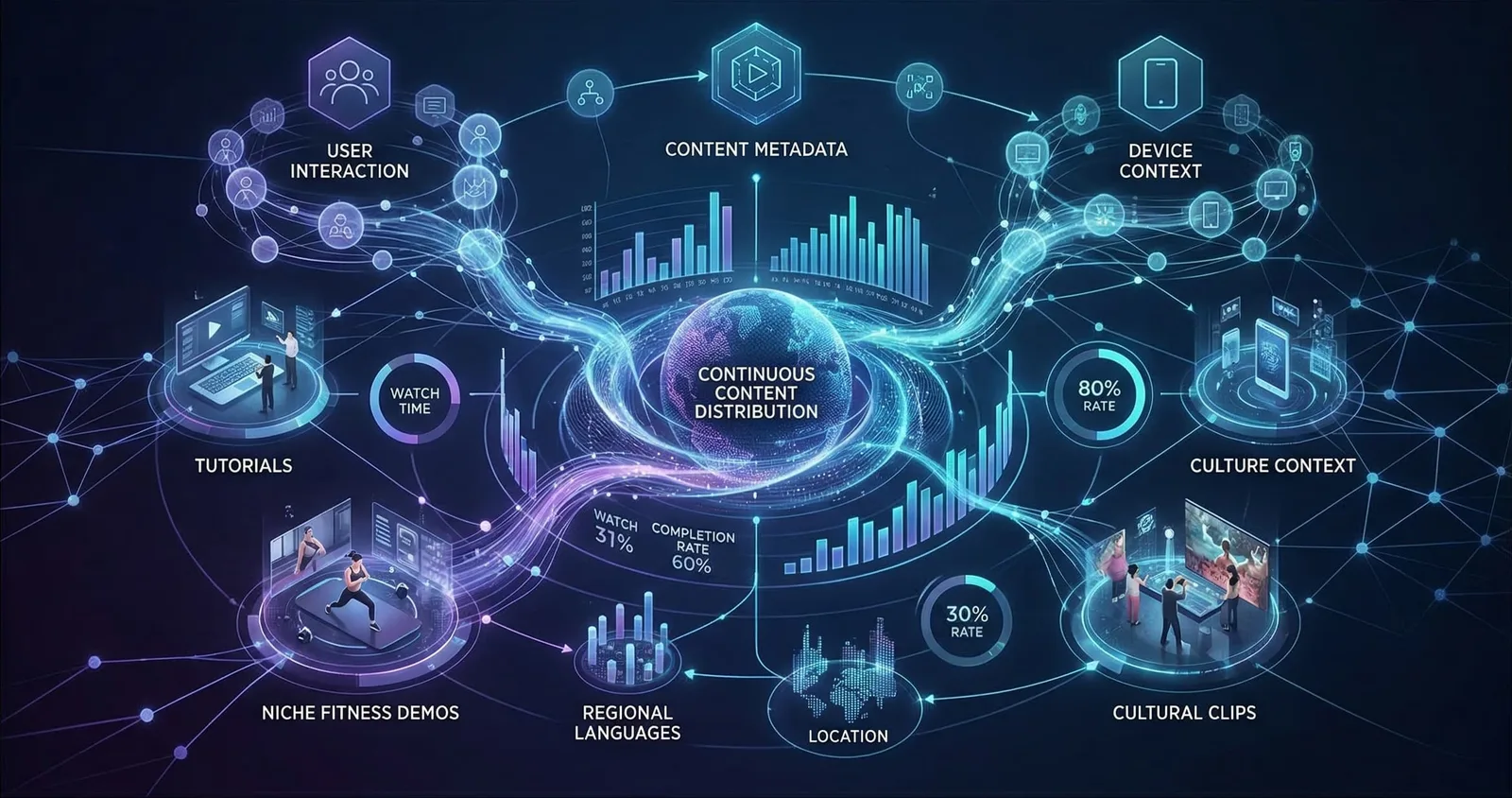
The most significant algorithmic change TikTok has implemented in recent years is the shift toward watch time and completion rate as primary ranking signals, moving away from an earlier model that weighted likes and follower counts more heavily. This change has had significant implications for content strategy: it rewards creators who optimize for viewer retention rather than those who simply produce high volumes of content or have accumulated large followings.
A second major development is the improvement in TikTok’s content understanding capabilities. The platform now categorizes content with considerably more granularity than it did in 2022 or 2023, enabling specialized content to find relevant audiences more efficiently. Educational content, in particular, has benefited from this change — a creator publishing detailed tutorials in a technical niche can now expect meaningful organic distribution to users who have demonstrated interest in that niche, rather than being filtered out by low initial engagement from general audiences who don’t find the content relevant.
TikTok has also expanded its geographic and language-specific recommendation systems, making it easier for content produced in regional languages to find audiences within those language communities rather than being deprioritized in favor of English-language content. For creators targeting non-English-speaking markets, this change represents a meaningful expansion of organic reach potential.
The practical implication of these changes is that content quality — specifically, content that viewers choose to watch completely — is the most durable ranking signal available. Trends, sounds, and hashtags create short-term distribution boosts, but completion rate is what converts an initial boost into sustained algorithmic promotion.
User interactions remain the clearest real-time feedback mechanism the TikTok algorithm has for evaluating content quality. Likes, shares, comments, and saves each carry different weights and convey different information. Shares are generally the strongest positive signal — a user who shares a video is implicitly endorsing it to their own network, which the algorithm interprets as a high-confidence quality indicator. Comments signal engagement depth. Saves indicate that a viewer found the content useful enough to return to. Likes are the lowest-friction interaction and carry correspondingly less individual weight, though they contribute to aggregate engagement rate calculations.
The ratio of interactions to views matters as much as the absolute numbers. A video with 500 comments from 10,000 views signals stronger quality than a video with 500 comments from 500,000 views. Creators who understand this ratio dynamic focus on producing content that generates proportionally high engagement rather than content designed to maximize raw view counts.
Encouraging specific interactions requires embedding prompts directly into content — but the execution matters. Mechanical calls to action (“like and follow for more”) are less effective than interaction prompts that are genuinely integrated into the content. A travel creator who asks viewers to share their own destination recommendations in the comments is generating interaction that enriches the content’s comment section, which in turn signals genuine community engagement to the algorithm. The interaction prompt serves the viewer and the algorithm simultaneously, which is the mark of a well-designed engagement strategy.
There are legitimate reasons to want to recalibrate what TikTok’s algorithm shows you or thinks you are. Accounts that have drifted into content categories that no longer reflect their focus area — through casual browsing, automated activity, or previous brand experiments — can find their For You feed populated with content that no longer serves their goals, and their own content being distributed to audiences that aren’t the right fit. A systematic reset addresses this by clearing accumulated signals and rebuilding the algorithm’s understanding of the account from a cleaner baseline.
The reset process is most relevant for accounts undergoing a significant content pivot — a creator shifting from entertainment to education, a brand moving from a broad awareness strategy to a specific niche, or an account recovering from a period of inconsistent content. In each case, the accumulated interaction history is working against the desired new direction, and a deliberate recalibration is more efficient than simply waiting for the algorithm to naturally reweight.
To reset the TikTok algorithm, follow these steps:
After completing a reset, the key to maintaining the new algorithmic baseline is consistency. Interaction patterns that reintroduce signals from previous content categories — even casually — will begin pulling the algorithm back toward old patterns. Treat the post-reset period as a sustained commitment to the new direction rather than a one-time action.
The most common reset mistake is treating it as a single action rather than a process. Clearing watch history without subsequently engaging deliberately with target content achieves little — the algorithm simply begins rebuilding the same model from scratch based on whatever the account interacts with next. The reset only produces lasting results when paired with intentional engagement in the new direction.
A second frequent error is inconsistent engagement during the recalibration period. Users who clear their history and then interact sporadically with both old and new content categories send mixed signals that produce a muddled algorithmic profile rather than a clean realignment. During a reset, the engagement pattern should be as deliberate and consistent as possible for at least two to three weeks to give the algorithm sufficient new signal to work with.
Finally, many users underutilize the “Not Interested” feature, treating it as an option rather than a tool. Systematic use of this feature is the fastest way to suppress unwanted content categories during a reset. Creators and account managers who build this into their daily TikTok routine — not just during resets but as ongoing account hygiene — report significantly cleaner For You feeds and more accurate distribution targeting for their own content over time.
TikTok’s active user base exceeded 1.5 billion monthly users in 2026, making it one of the largest content distribution systems in the world. The scale of the opportunity is real — but so is the competition for attention. The creators and brands that consistently achieve high view counts do so through a combination of trend awareness, content quality, and structural engagement optimization rather than through any single tactic.
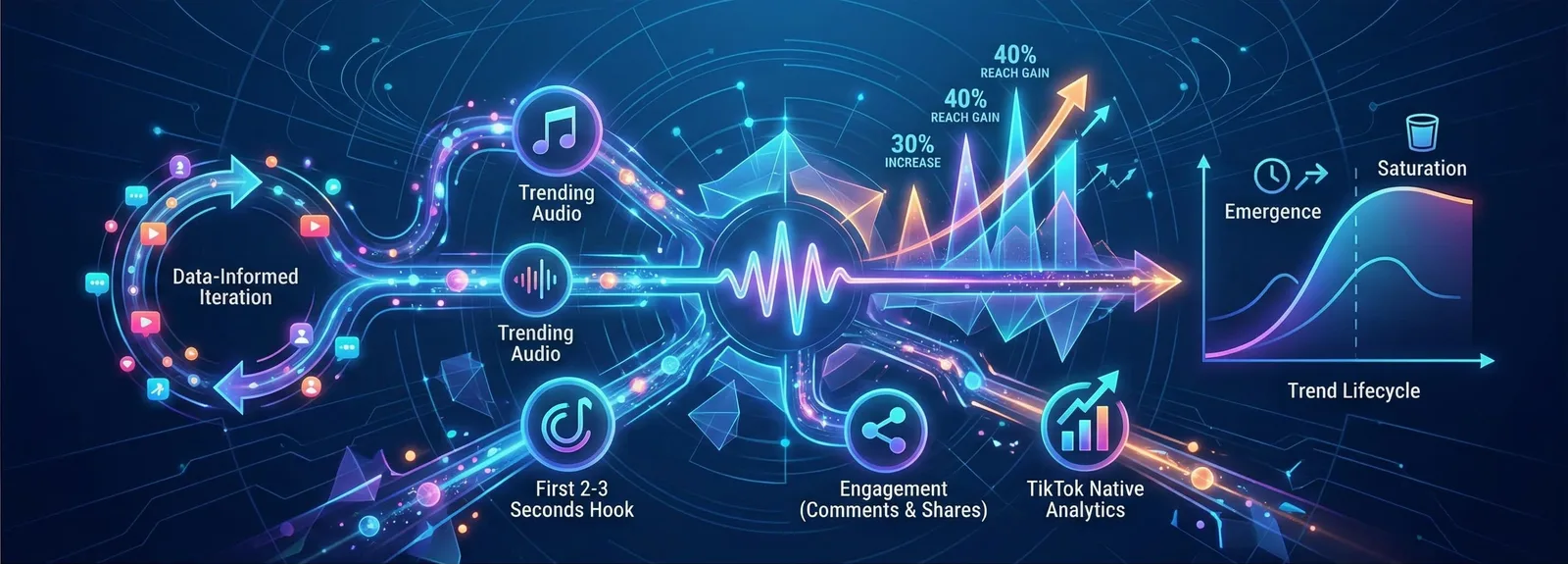
Trending audio is one of the most immediate levers available. TikTok’s algorithm actively boosts content that incorporates sounds gaining traction on the platform, giving videos using trending audio a meaningful distribution advantage in the days when the trend is ascending. Creators who monitor TikTok’s Discover page and the Creative Center’s trend intelligence tools consistently can identify audio trends early enough to participate before saturation, which is where the highest distribution uplift occurs. Videos incorporating trending sounds during the early adoption phase can see engagement rates 25–30% higher than equivalent content using non-trending audio.
Content structure — specifically, the first two to three seconds — determines whether a video’s completion rate will generate positive algorithmic signals. A strong hook that creates immediate curiosity, emotional resonance, or a clear value proposition is the single most effective structural investment a creator can make. Videos that lose viewers in the first three seconds never recover algorithmically; videos that retain viewers past the five-second mark are far more likely to achieve high completion rates and subsequent distribution boosts.
Engagement tactics that generate comments and shares — rather than just passive views — amplify distribution reach meaningfully. Content that sparks conversation, debate, or community participation has been shown to achieve reach increases of 35–40% compared to comparable content that generates only passive engagement. Building conversation prompts into content structure, not as afterthoughts but as integral elements of the video’s narrative, is the most reliable way to generate this kind of high-quality interaction.
Using TikTok’s native analytics tools to track which content formats, topics, and posting times generate the strongest performance metrics is foundational to any sustained view growth strategy. Data-informed iteration — publishing, analyzing, and adjusting based on actual performance rather than assumptions — is what separates creators who plateau from those who compound their growth over time.
Trend participation on TikTok is most effective when the trend is adapted rather than simply replicated. A creator who participates in a trending format while integrating elements specific to their niche produces content that benefits from both the trend’s algorithmic boost and the niche relevance that drives completion rates among their target audience. Direct replication of a trend — without any original layer — tends to get lost in a crowded field of identical content and delivers diminishing returns as the trend matures.
Timing is critical. TikTok trends typically have a lifecycle of days to two weeks from emergence to saturation. Content published during the first third of that cycle receives the strongest distribution benefit; content published after saturation tends to underperform relative to the creator’s own baseline. Monitoring emerging trends through the Discover page, watching what top creators in your niche are engaging with, and tracking trending sounds in the TikTok Creative Center are the most reliable early-signal sources available.
A food creator who adapted a trending dance challenge by incorporating cooking movements — transitioning between recipe steps in time with the choreography — provides a useful model for this approach. The content was immediately recognizable as participating in the trend, which generated discovery traffic from trend-followers; simultaneously, the culinary execution gave it specific appeal to the creator’s existing food audience, generating the high completion rates that converted trend traffic into lasting follower growth. The trend created the initial distribution; the niche execution made that distribution productive.
A consumer technology brand launching a new device in a saturated market chose TikTok as the primary channel for product awareness in early 2026. Rather than producing polished promotional content, the brand partnered with a group of mid-tier tech reviewers with established, highly engaged niche audiences — creators whose followers actively sought out tech opinions and demonstrated high engagement rates on review content specifically.
Each creator was given the device and a brief that outlined key features to highlight, with full creative freedom over format and presentation. The resulting unboxing and first-impression videos were genuinely variable in style and perspective — which was intentional. Authentic variability across creator voices made the campaign resistant to the “coordinated advertising” perception that tends to reduce engagement and trust on social platforms.
The results were measurable and significant: the campaign generated sustained organic sharing beyond the initial posting window, drove meaningful traffic to the product page, and produced a pre-order spike that exceeded projections. The key mechanism was creator credibility: audiences who trust a tech reviewer’s independent opinions responded to their coverage of the device as a genuine recommendation rather than sponsored content, even though proper disclosure was maintained throughout. The campaign demonstrated that influencer partnerships built around creator credibility rather than creator reach consistently outperform those that prioritize follower count over audience trust.
Managing multiple TikTok accounts simultaneously — whether for different clients, different market segments, or different content verticals — creates operational and security challenges that standard browser sessions cannot address. TikTok’s detection systems are specifically calibrated to identify account clusters operating from shared device environments, and the consequences of triggering those systems can affect all accounts in the cluster simultaneously. This is the core problem that GenLogin is designed to solve.
GenLogin provides isolated browser profiles, where each profile maintains an independent fingerprint, cookie store, local storage, and proxy assignment. From TikTok’s perspective, each GenLogin profile represents a completely distinct device operated by a different user — because at the signal level that TikTok’s detection systems evaluate, it genuinely is. There is no shared state between profiles that could allow TikTok to correlate them into a cluster. This architecture makes it possible to manage accounts for multiple clients, multiple geographic markets, or multiple content verticals from a single workstation without the account separation risks that come with standard multi-account approaches.
A digital marketing agency managing TikTok campaigns for multiple clients provides a clear illustration of the operational value. Each client account needs to operate as a completely independent entity — with its own interaction history, its own audience targeting, and no cross-account signal contamination that could trigger TikTok’s multi-account detection. GenLogin’s profile isolation enables this at scale, allowing the agency to run concurrent campaigns across separate accounts without requiring separate physical devices or operating systems for each client.
The GenLogin Marketplace extends this capability with automation scripts that can handle routine account management tasks — content scheduling, engagement actions, analytics collection — across multiple profiles simultaneously. For teams managing high volumes of accounts, this automation layer reduces the manual overhead of multi-account operations while maintaining the profile-level isolation that keeps each account secure.
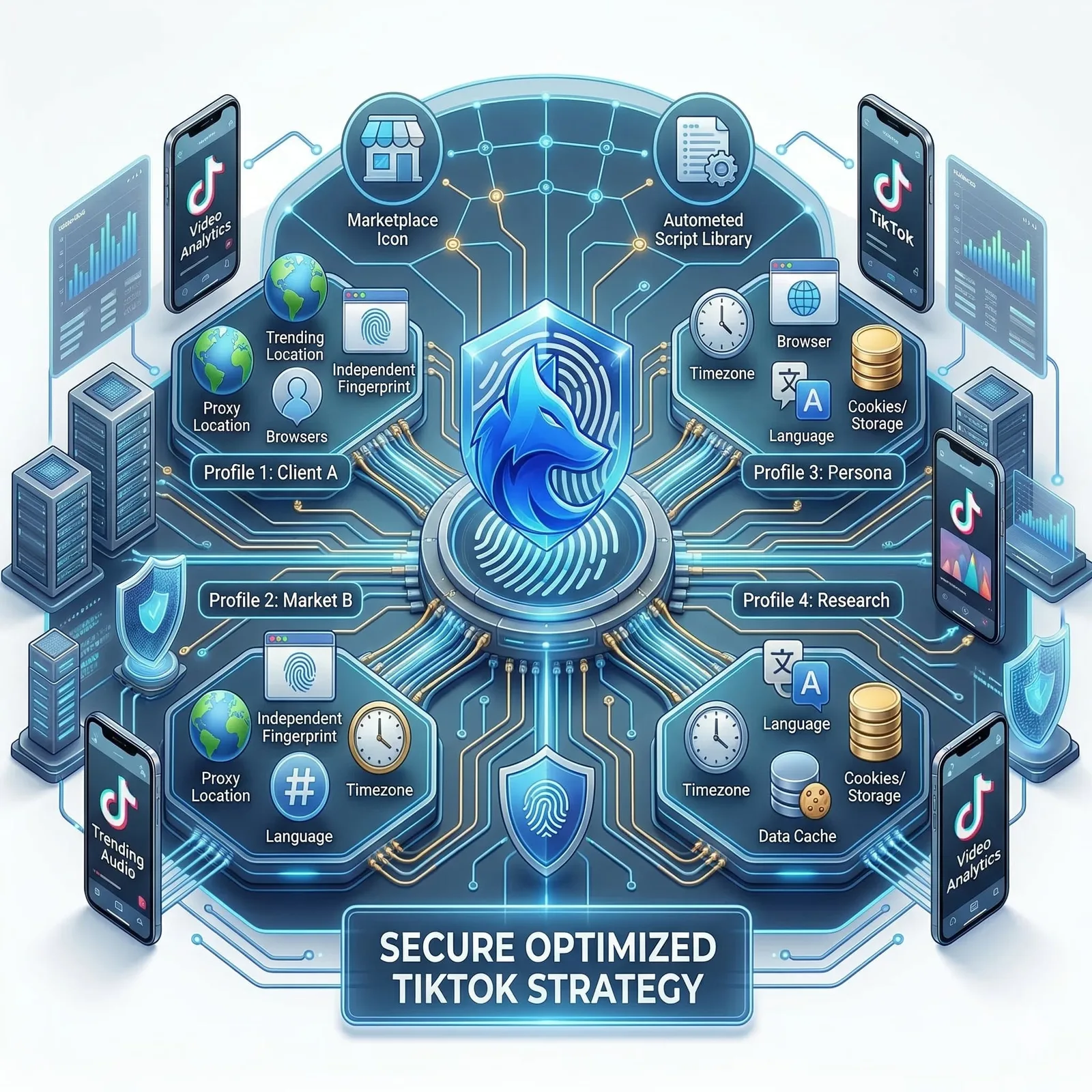
GenLogin’s feature architecture maps directly onto the requirements of professional TikTok account management. Profile isolation is the foundational capability: each browser profile runs in a fully sandboxed environment with independent fingerprint parameters covering canvas, WebGL, audio context, navigator properties, screen resolution, timezone, and language settings. TikTok’s client-side scripts actively probe many of these signals, and consistency between the proxy location and the fingerprint profile’s contextual signals — timezone, language, keyboard layout — is what prevents the location-mismatch flags that trigger security review.
Proxy integration is native and supports HTTP, HTTPS, SOCKS4, and SOCKS5 protocols, with per-profile proxy assignment and geolocation-aware fingerprint configuration. Users can import proxy lists and assign them to profiles in bulk, and GenLogin surfaces IP geolocation data alongside each profile to make location consistency auditing straightforward. The platform supports both static proxy assignments for accounts requiring consistent IP identity and rotating proxy configurations for research and data collection workflows. Verify proxy quality before deployment using tools like Pixelscan or Whoer to confirm IP geolocation accuracy and check for WebRTC leaks.
The data collection capabilities accessible through the GenLogin Marketplace enable structured market research alongside account management. Creators and agencies can use GenLogin to systematically collect data on competitor content performance, trending audio adoption rates, hashtag saturation levels, and audience engagement patterns — building the longitudinal datasets that inform genuinely data-driven content strategy. An independent creator using GenLogin for research can maintain separate profiles for different research tasks, keeping research activity cleanly separated from managed account profiles and ensuring that research-generated signals don’t contaminate the accounts they’re managing.
For individual creators managing content across multiple themes or personas, the ease-of-use dimension matters: GenLogin’s interface is designed to be operationally accessible without requiring deep technical expertise, making professional-grade profile isolation available to small teams and solo operators who don’t have dedicated IT infrastructure.
TikTok’s algorithm in 2026 rewards creators and brands who approach it with structural understanding rather than intuition. Completion rate, interaction quality, content metadata coherence, and consistent engagement with target audiences are the durable ranking signals — trends, sounds, and reset techniques are tactical tools that work within this structural framework, not substitutes for it. With over 1.5 billion monthly active users, the platform’s distribution potential is substantial, but consistently capturing that potential requires ongoing, data-informed adjustment rather than one-time optimization.
For anyone operating TikTok at scale — managing multiple accounts, running campaigns across market segments, or coordinating content across client portfolios — the infrastructure layer matters as much as the content layer. GenLogin addresses the specific infrastructure requirements of professional TikTok operations: profile isolation that prevents cross-account detection, proxy integration that maintains geographic consistency across managed accounts, and automation capabilities that reduce the operational overhead of multi-account management without compromising account security.
The practical next step depends on where your current TikTok operation has the most room to improve. If content strategy is the gap, apply the algorithm insights and engagement frameworks in this article systematically and measure the impact over four to six weeks. If account management infrastructure is the constraint, explore what GenLogin’s profile isolation and automation capabilities can do for your specific workflow — visit the GenLogin Marketplace to review the available scripts and identify the tools that fit your operational requirements.